Tuesday, April 8, 2014

Average Eastern Right Of Way

With the Class 1 loops in operation it was time to move on to the Average Eastern roadbed. I'm reusing the spline from the aborted Allegheny Eastern so it goes pretty fast. Rather than building roadbed I just have to join recycled sections with splices. These are just styrofoam strips glued to both sides of the joint. I'm only using splices on the elevated sections. Where the roadbed sits right on the deck I just fasten the sections in place with drywall screws. It's crude and looks kind of "Frankensteinesque" but it's effective.

I started at East End and worked "west"...
East End

The vertical supports are stacks of spline roadbed cut into short sections and glued together. The shorter columns are anchored to the top with screws, the tall ones are glued...
Looking Towards the Powerhouse and Carbon Point

I used the 2" thick sheets that were once Juniata at Quotidian. The 4' x 6' industrial area is one big styrofoam slab. The spline butts up to it on either side...
Quotidian

I used a combination of curved and straight sections. The spline is really flexible when split into single track roadbed (it was four and two).and can be easily adapted to the new track arrangement. Alpha is a prime example of tightening and straightening curves...
Alpha

Coming into Owertown I was able to use some long pieces of straight spline. Some of the sections are straightened curves...
Owertown

The roadbed for the mainline is almost complete. I made it to the east end of Average. I'm currently in the process of figuring out the yard. I have some sections of 2" slab left and I may use those. In the meantime I laid track between East End and Quotidian. After dinner I took a break and set up some staged shots. Since three levels are now "tracked" I decided the best place for the pictures would be at the triple crossing. The ABC Railroad d'jour is the Pennsy. The XYZ Railroad is represented by the E6 and the FM "Baby Trainmaster.(I'm looking to buy some Lackawana F Units). The top level is the Average Eastern. The Connie is still lettered for the NYC because I'm a bit skiddish about removing the lettering...


The rooadbed for the "fourth" level, the Q' Company, has yet to be constructed. I'm out of recycled spline and will have to lay up one for the mining operation. When I do I'll document how the spline is created.

Regards,
Frank Musick

Building a dream layout on a nightmare budget
The Average Eastern Railroad


Saturday, April 5, 2014

Layover

In the past I've related how operating the "virtual" trains on the track plan revealed shortcomings in the track arrangement. Running real trains can do the same thing. Watching the test trains moving around the loop it became apparent that a single loop wasn't a good way to represent two different rairoads. One problem is the fact that all the current consists are all Pennsy, so both PRR equipment appears on both "railroads". The other issue is the schedule of the Class 1 trains. The run is quite short and the trains appear too frequently for my tastes. It's not a problem when operating the loop for the grandkids. During actual operating sessions, however, it is not gonna cut it.

The first concern can be overcome  issue by creating two separate loops. That's a bit challenging because there really isn't enough room. One of the loops has to cross over the other. Crossing at grade would result in collisions. The only solution is to go up...
Average Eastern Trackplan, April 5th, 2014

I backed up a bit on construction and revised the roadbed. Thankfully, the styrofoam splne makes this pretty easy. There are now two independent loops. The lower one passes through Average...
Lower Loop

The upper one connects to the AE at East End...
Upper Loop
The upper loop is supported by 2.5" styrofoam columns spaced on 8" centers. The roadbed for the Average Eastern is supported on similar columns, but with varying height. The highest point on the AE main is About 7" off the "deck" or top of the benchwork. This is just west of Carbon Point where all three mainlines cross over each other...
Triple Crossing
The resulting triple crossing makes a tempting scenery element, but won't be readily obvious. This is because the rear of each Class 1 loop will serve as "staging". There are no staging yards, so it's more like layover trackage. This will solve the frequency issue on the Class 1's. The trains will simply stop and wait for their scheduled appearence time at Average or East End. This probably won't happen right away. Some sort of timing circuit will need to be created. In the near future the trains will just loop the loops.

The Q Co tracks will be supprted on columns the same way as the AE, but at 7.5" to 8" above the benchwork.

Those of you who may have noticed that there is only .5" of clearance where the tracks cross over each other can take heart in the fact that there will be openings of the proper size. With the spline construction it's just easier to create the proper opening after the spline is in place.

Regards,
Frank Musick

Building a dream layout on a nightmare budget
The Average Eastern Railroad


Wednesday, April 2, 2014

Running Trains

I'm not sure how many months it has been since it happened last, but yesterday trains were running on all four of the mainline tracks. The "trains" consisted of locomotives, two steam and two diesel, running light around the mainline loop. At the present time only the loop is operational...
Mainline Loop

The loop simulates the two railroads the Average Eastern connects to. It appears as a Class 1 four track mainline at Average and along the river east of Quotidian. Passing Carbon Point and East End it resembles the two track main stem of another Class 1. The track is laid, but really needs a lot of tweaking before it will look like the well maintained roadbed it's supposed to be.


Mainline trains are powered and controlled by two MRC "Dual Loco Pack" transformers. Both have modulated DC, or "pulse power options. The pulse power leads to some unexpected results. It's easier to show than explain so I made a video of the test runs. Please forgive the quality. They were taken with a cell phone...


The Pennsy L1s is a Kato Mikado with a pewter GHQ kit. It runs as we've come to expect from a Kato product. The real surprise is the Pennsy I1s. It's a ancient Minitrix model. It has been modified cosmetically to center the steam pipes on the smoke box. The driver flanges were ground down to suit codde 55 rail. Other than that it is pure Trix. No motor or gear mods. I think the electrical pickup may have been improved with extra wiring from the tender, but I didn't do it. I bought the beast second hand. A good part of that crawl can be attributed to the modulated DC. I did find that this stunt requires VERY clean track.

I've been going through the roster and checking to see what locomotive needs what work. Looks like most of them need some kind of repair. A lot of it is cosmetic, but quite a few don't run well at all. The rolling stock also needs a good going over.

Some of the Average Eastern roadbed is already in place but it'll be a while before a train can run through from Average to East End. To save money most of the switchwork will probably have to be hand laid. Fortunately I standardized on #7 turnouts. That should make that portion of the project a bit easier.

That's all for now.


Regards,
Frank Musick

Building a dream layout on a nightmare budget
The Average Eastern Railroad


Wednesday, March 26, 2014

Progress Shots

Stripped the benchwork bare. Talk about a fresh start...
"WondrBoard"
I covered the entire thing with 7/16" OSB. The top is meant to protect the stuff stored under the layout and keep expensive locomotives from falling to the concrete floor. The 2" high spline roadbed is laid on the top. It's the same laminated styrofoam spline I used on the first layout.

Because OSB is not as stable as plywood I secured the top with drywall screws every 12" along the frame edges and cross rails. I then laid the full size drawing directly on the completed top. I did not feel it was necessary to glue the drawing in place. I used strategically placed thumb tacks to keep it from wandering away. It will serve as a general guide for locatig track and other features...
The Full Size Plan
As I was laying out the full size drawing I found a "small" oversight. There is no benchwork at the location where the Average enginehouse should go. It was cut at an angle to provide a wider aisle with no pointy corner to skewer the operator's rib cage...
DUHHH!
 I redrew the plan to represent the actual corner and rotated the engihouse 180'...
Fixed!

Then I dove straight into the roadbed installation. Since I was able to reuse the styrofoam spline from the Allegheny Eastern things went very fast. I used huge sections cut from the old layout. It was a bit like using sectional track. I screwed it directly to the top with drywall screws. The roadbed for the "Class 1" connecting railroads is already completed and ready for track...
Average Looking From The Enginshouse

The roadbed for the Average Eastern is elevated on blocks of styrofoam. The AE railhead sits about 2" or higher above the connecting roads. I started at East End and worked towards Average. Because of the spline construction I can build the roadbed first and elevate it afterwards...
East End Looking From Old Wye Road

Currently the road bed for the AE right of way ends just east of Quotidian, where the Wm. H. Taylor building will be...
East Of Quotidian


I started laying track for the "mainlines" on the Average side...
Average Eastern Trackplan March 24th, 2014


The big loop will the first part in operation. I'll have a place to run trains while I construct the balance of the layout.

Regards,
Frank Musick

Building a dream layout on a nightmare budget
The Average Eastern Railroad


Wednesday, March 19, 2014

Construction...Er...Reconstruction Begins

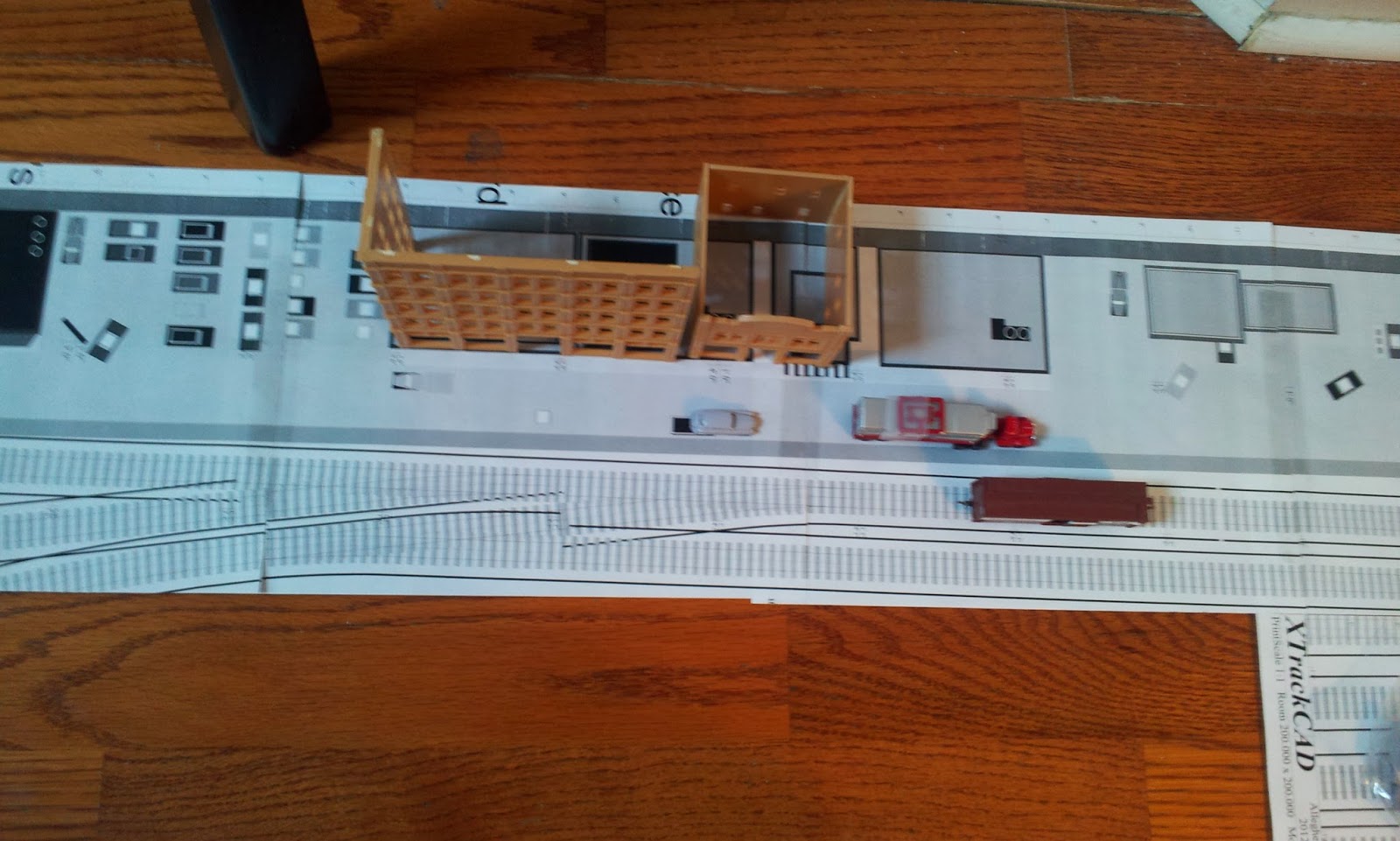
Having spent what seems an eternity on the track plan, I started to print it out full size. The first hardcopy was the town of Average and it's main drag, Muir Street. I printed 8.5" x 11" sections and taped them together. I know Kinko's will print my plan in 3' x 15' strips but on larger layouts it gets expensive pretty quick.

Anyhow, I laid the resulting 9' long drawing down in the long hallway in our home. I then grabbed a few odds and ends from the garage to check the scale of the drawing. I "mocked up" the area around the Studebaker dealer...
Average: "Mockup" of Muir Street 

This is the most detailed track plan I've ever done and it was pretty cool to see it full size. It's ambitious, to say the least...
Average: 1:1 Scale

There were a few things I needed to learn based on this printout. For those who may use XTrackCAD some advice on the print settings...Best to print as many "tiles" as you can at the same time. I printed in batches and sometimes the ruler marks seem to change. It was as if the basepoint of the drawing had shifted. To get the most real estate out of each tile I suggest you make sure "Engineering Data" and "Ignore Page Margins" are NOT checked....
XTrackCAD Print Settings
Once I figured that out (sort of) I printed out the rest of the layout. Roughly 330 pages later (the trimming takes forever) I started assembling the tiles into cohesive strips. I split the layout into 4 basic areas. Average, Owertown and East End are separate sheets about 4' wide and over 12' long. The two 4' x 5' peninsulas, Quotidian and Alpha, are separate sheets.
Pile of Printouts

This time around I'm combining two ideas tested in previous incarnations. The styrospline road bed will be used again, much of it quite literally. The stuff is flexible enough that it can be reused and recurved if need be. A lot of four track roadbed will be split to make single track right of way. Rather than mount the styrofoam over open benchwork, I've decided to put a "top" on the "storage system" that supports the layout. The top isn't to lay track on, it serves more as a safety net for trains that happen to leave the track. The 600 scale foot drop to the concrete has cost some money in rolling stock and motive power. The top will reduce that plunge to mere inches. No more Kato Mikados vaporizing on impact. It will also help keep the mess of the layout construction out of the storage area, a concern that was recently brought to my attention by a certain female personage.

Once the top is installed all the paperwork gets glued down with wallpaper paste...Makes sense, right?

In other news...Now that I've acquired the AE's first 2-8-0 there is self-imposed moratorium on major purchases like locomotives, That, of course, does not apply in those cases where it would be stupid not to buy something. Still, it really doesn't make much sense to buy more trains until there's track to run them on. 

Apart from that, I'm slowly acquiring bits and pieces for scenery and the like. Vehicles for the good people of my small towns are being purchased from fellow "Railwirian" who goes by the user name of Rasputen. I feel his resin vehicles are among the best available in N scale. Separately castings for the body and the interior/chassis allows "see thru" construction. This is done without the oversize window posts found on other cast vehicles. There is some flash that needs to be removed but once that's out of the way...
"See Thru" Vehicles

There's no "glass" in the window openings, but that's just fine with me. Maybe if I can find something clear enough to reveal the interior I'll install "windows". I think these models provide excellent craftmanship at an affordable price. In addition to the ones I already own I just ordered a small herd of 1950 Studebaker "Starlight" coupes for Zellner & Howard, the dealership in Average...
Muir Street: Studebaker Dealer
1950 Starlight Coupes

While we're talking about vehicles, another source I use is the E-Bay store Willmodels. The resin models are highly detailed and affordable. They lack the open windows but that's not a problem. Besides, where else can I get  trucks like these...
Muir Street: GMC Cab Over Moving Van and Semi

Just to be fair I do own Mini-Metals models, but they get rather expensive on a larger layout. I also have problems with the appearance of the N scale vehicles. The HO scale are absolutely beautiful but lose a lot in translation. I really don't feel the 1:160 models are worth the price, especially when compared to the resin products mentioned above.

This payday the top goes onto the benchwork and roadbed construction will start. I'm really anxious to get started.

Regards,
Frank Musick

Building a dream layout on a nightmare budget
The Average Eastern Railroad


Friday, March 7, 2014

Downtown Average

I discovered that the revised trackage for the Average interchange wouldn't work. I had added a lengthy drill track, but it wasn't in the right place. While trying to get a cut of cars from the interchange to the yard I realized I had no where to go. The main culprit lay in this collection of turnouts...
Average: Bad Design

I had to fool around with things a while, but this modification seems to work. At least it seems to for the present....
Average: Revised Yard Throat

I've made up a few trains in the yard and switched the interchange without fouling the main or running out of room. The drill track can handle about ten 40' cars and a 2-8-0 locomtive. The industry lead for ACME Corporation is now east of here off the main stem. I added a turnout at the east end of the drill track, essentially creating a run around. The locomotive can now escape if need be. It also serves as an alternate route to the yard....
Average: ACME Corporation


With the yard redesigned I found I now had room to model the town of Average to some extent. It's main drag, Muir Street, parallels the tracks for its entire length. Most of the names are from businesses or people I knew in Philly. Muir Street itself is named for a friend and colleague from my Train Simulator days...
"Downtown" Average

The Studebaker dealer is named for a real one in Forsythe, Georgia. The photo was taken in March of 1955...
Zellner & Howard Studebaker

I just noticed I managed to misspell it on the trackplan :-)

Like the Studebaker dealership, I tried to incorporate things that were once common place but are now just memories. All of the service stations represent oil companies that no longer exist or merged into oblivion. Names like Flying "A", Sinclair and Cities Service were everywhere. Mobil still exists, but its Pegasus symbol is no longer as prominent as it was back in the day...
Mobil Gas Station Sign

I suppose now I'll have to add a Hudson dealer at Owertown.

Regards,
Frank Musick

Building a dream layout on a nightmare budget
The Average Eastern Railroad


Wednesday, March 5, 2014

Sweating The Details

I keep fine tuning the trackwork for the layout. The changes are  minor realignments here and there. One thing I did was to reduce the amount of hidden track. I also decided to eliminate a few of the tunnel portals. Tunnels are pretty rare considering. It's more likely for railroad tracks to disappear under a highway overpass. As a result there are only two tunnels represented. The first is where the four track mainline of "ABC" railroad leaves Average... The other is on the "XYZ" railroads two track mainline just east of the East End interchange. The opposite end of the "tunnel" is the highway overpass at the west end of Average...
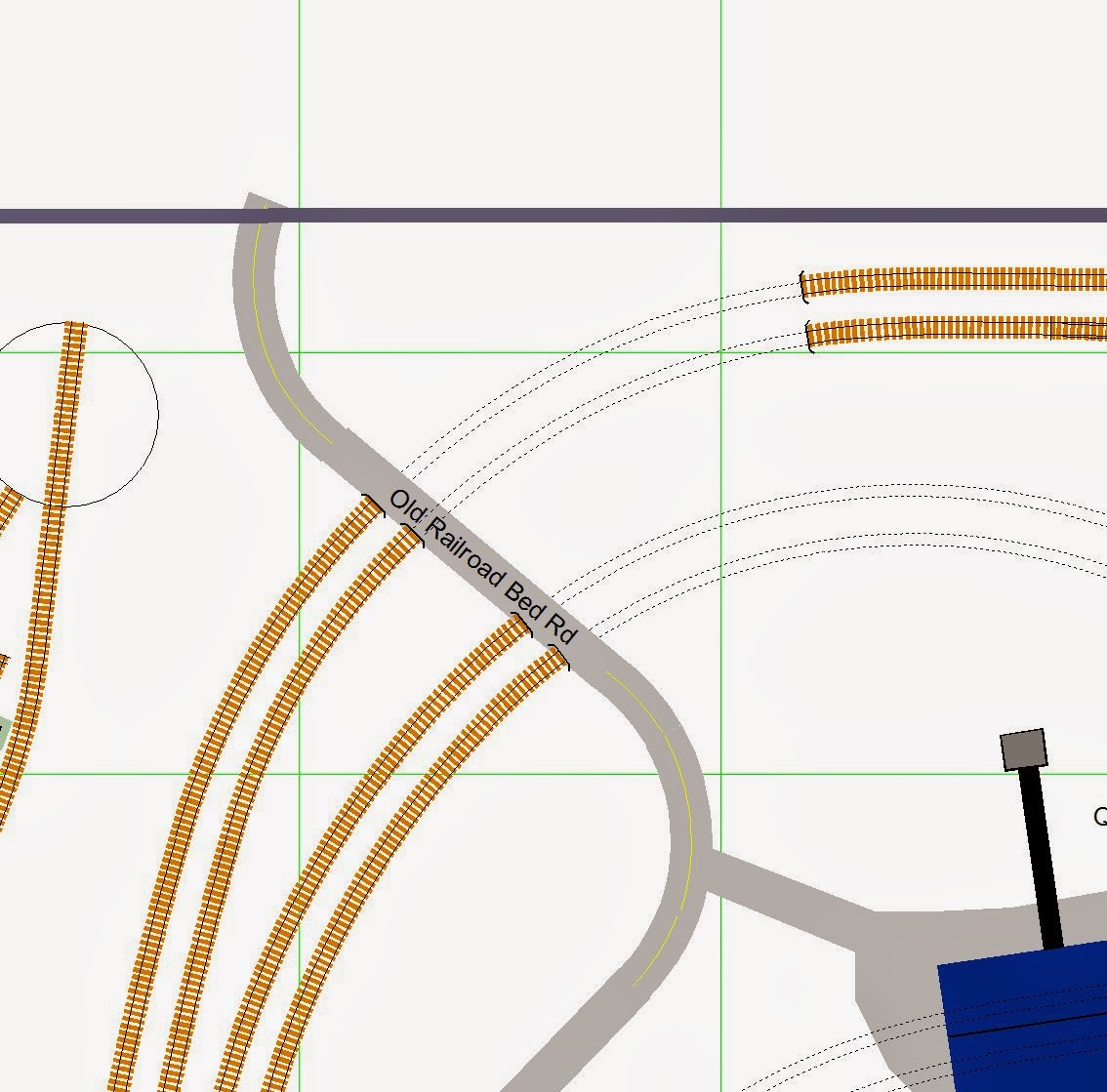
East End Tunnel and Average Overpass

I have also added more detail to the  trackplan. In doing so I found I had to make a few more modifications to the trackage...
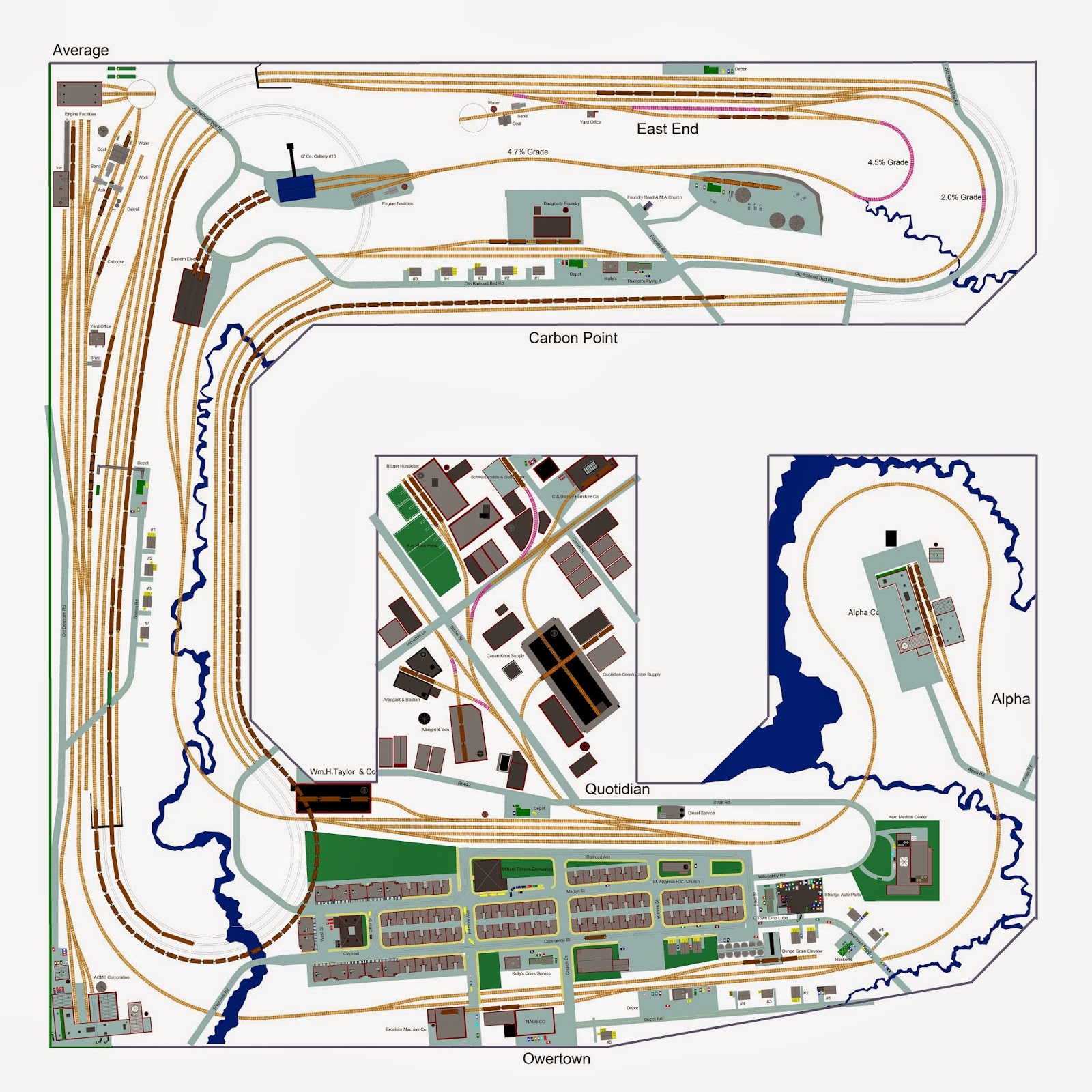
Average Eastern March 5th, 2014

While the actual layout may never actually be this elaborate, it sure is fun to see what I can come up with scenery wise. The Owertown/Quotidian portion reminds me of the Allentown/Bethlehem area. Like weeds in the garden, the two cities have grown into each other.

Most of the industry names I've used come from the real world. The only exceptions are the fictional ACME Corporation and the Quotidian Company, what the locals refer to as the "Q". Some businesses are named after companies I found on my Sanborn maps. Others, like O'Town Dino Lube, are adaptations from actual places. I searched the internet for different industries and got listings of names. I chose the ones that appealed to me. Some of them, like Strange Auto Parts, seem humorous but they are genuine.

There are several parts of the two towns, chiefly Owertown, that I spent time developing. There are several "vignettes", most of them featuring car or trucks to suggest that there are actually people in our miniature homes and industries. Owertown city hall, for instance, houses the police and fire departments...
Owertown City Hall

Then there is Milliard Fillmore Elementary, a public school. School is about to let out and all the buses and family station wagons are lined up waiting for the kids...
Milliard Fillmore Elementary School

While a large part of Owertown is rowhome residences, there is a commercial district centered on City hall. Located on the west end of town, it's afound bit like the town squares here in Tennessee. The square is surrounded by small businesses. There is a movie theatre, grocers, barber and other such...
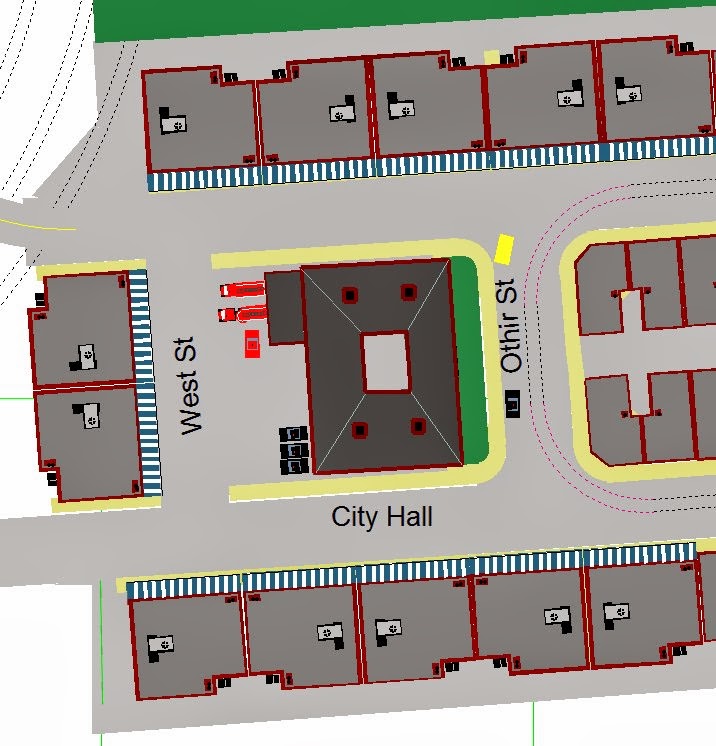
Commerce Square

On the east end of Owertown there is St Aloyisus Catholic Church, one of two churches in town. The other,  located on Church St, is Owertown United Methodist. A block or so from St Aloyisus is O'Town Dino Lube, the Sinclair service station on West St. Behind it, on Owertown Rd is Strange Auto Parts. East on Owertown Rd are some single homes and Rockett's, the local drive-in and hang out for the teens in town. The parking lot is usually full of chopped coupes, highboys, motorcycles and most anything else with wheels...
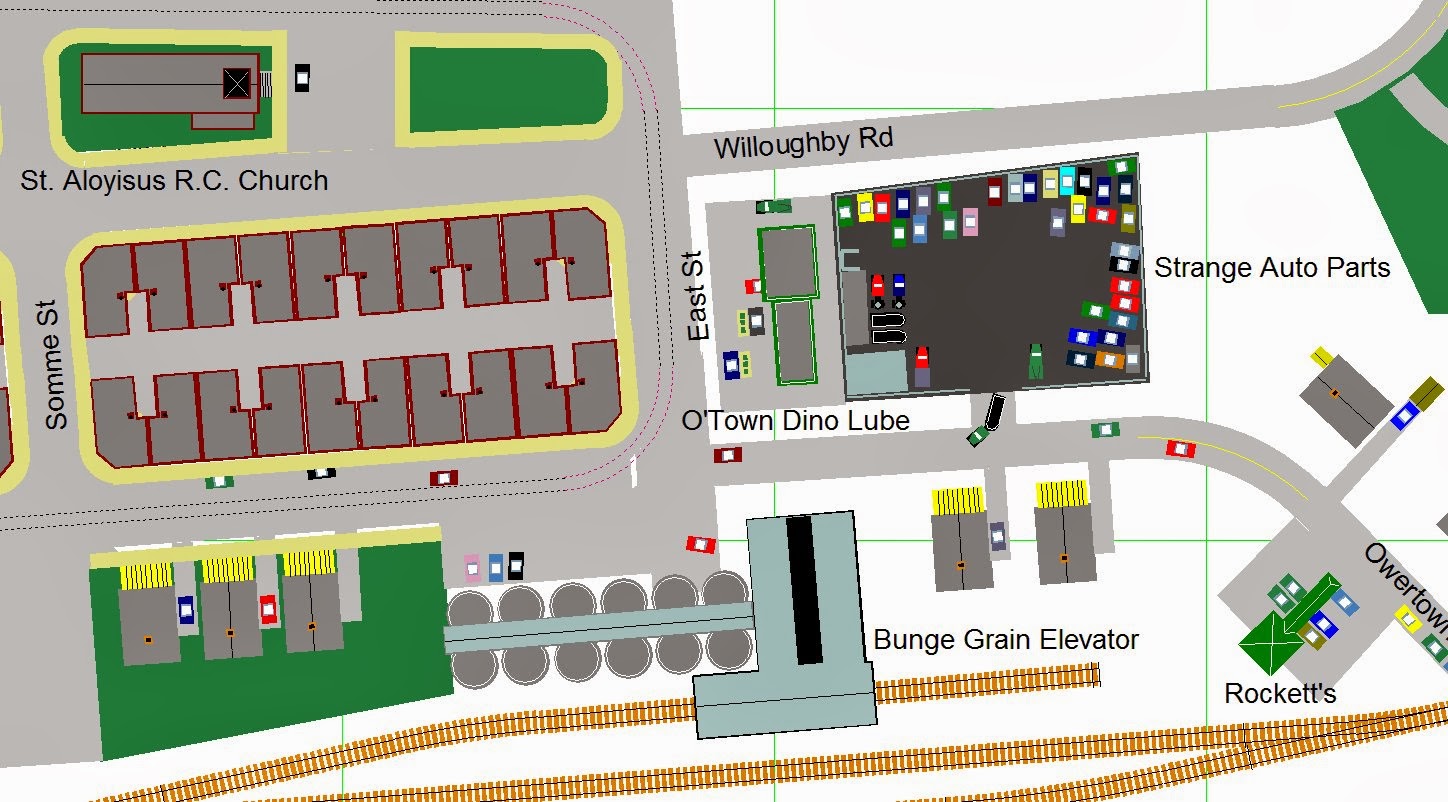
The East End of Owertown

The AE serves three big industries on the south side of town. One of them is the Bunge Grain Elevator across the road from the Sinclair station...
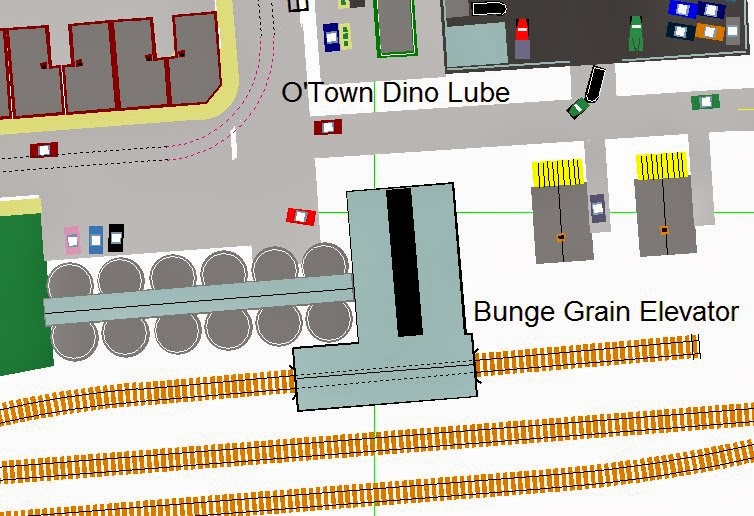
Bunge Grain

The other two industries are on the opposite side of the railroads main stem. One, the National Biscuit Co. originally sat on the opposite side of town, served by a siding that ran along Filmore St. I relocated it here and and added the Excelsior Machine building. The two companies share a siding...
Shared Siding


I had included an area east of town for a small farm but it seemed out of context. At one point it occurred to me that I had never seen a model railroad with a hospital. I removed the farm and replaced it with the Kern Medical Center...
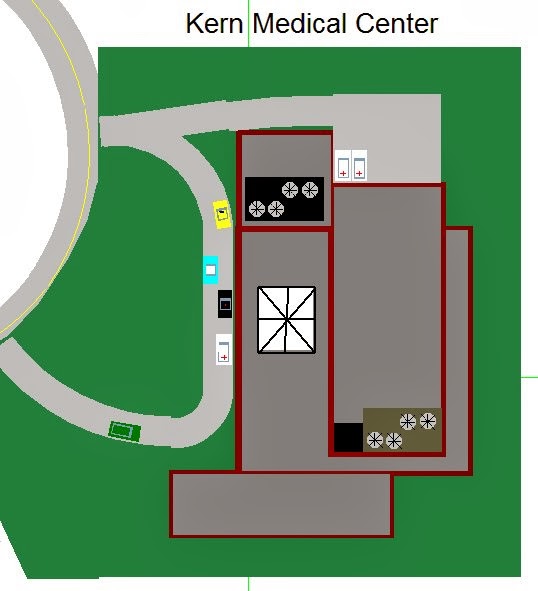
A Model Hospital?

One other item I added was something I wanted to incorporate into the Allegheny Eastern, but wasn't able to. Growing up in Philadelphia I had ridden the PCC cars of the PTC and P&W. I wanted to model something like this. The streets of Owertown are the home of Eastern Electric, a streetcar line. Nothing complex, just a simple loop around "downtown". I used dashed lines to indicate the tracks running in the street...
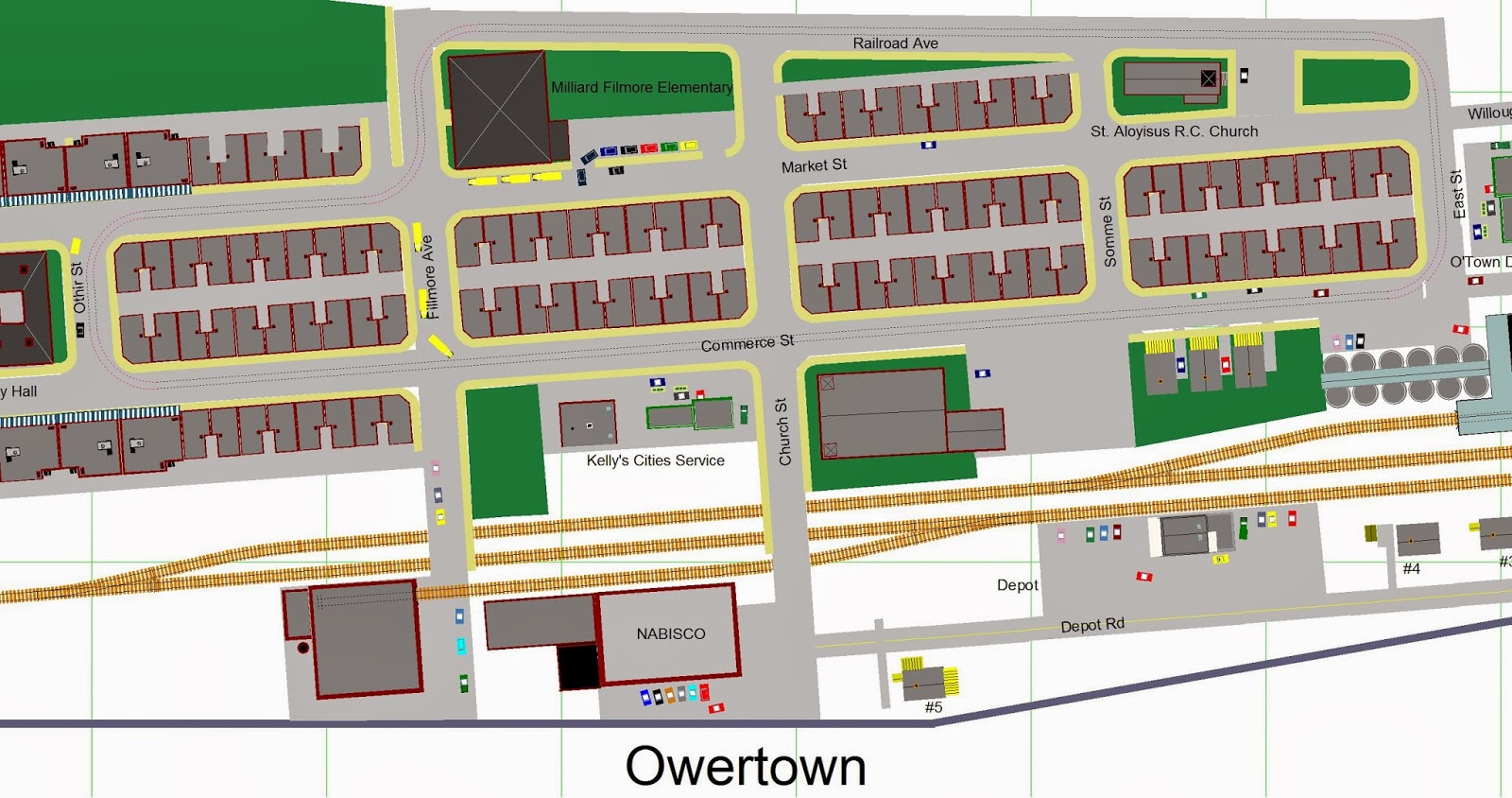
Eastern Electric Traction Company

The PCC cars are modified Bachmann products. I kitbashed a double ended unit from two Bachmann shells and painted it to resemble the trolleys of the Altoona and Logan Valley. There is also a "normal" PCC which has yet to be painted...
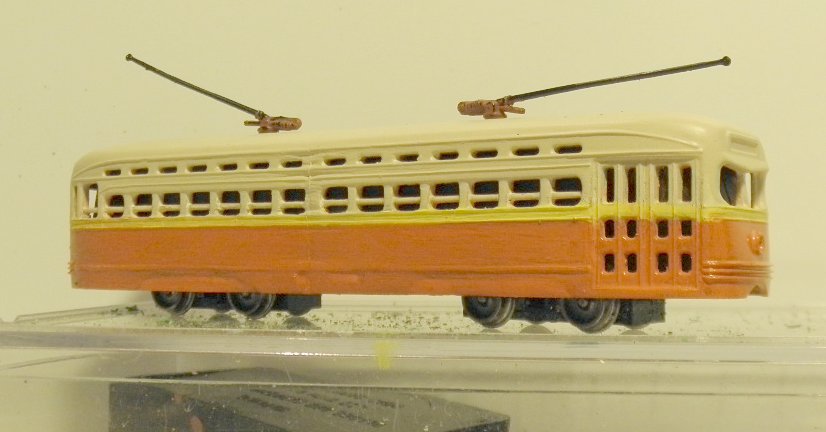
Eastern Electric Double Ended PCC Car

The only modifications I have made to these units is to grind down the frames so the cars sit at a more prototypical height. I have found that the Bachmann trolleys will negotiate very tight radius curves right out of the box. No rework is necessary. As a result all the curves are 3" radii.

If my memory serves me right many larger northeastern communities consist of rows of identical buildings. There are differences, but they are mostly cosmetic and reflect the preferences of the owner. It seems to me that the best way to model the rowhomes and businesses around city hall is to build each block as a single unit, with sidewalks and alleys and other details. Each block can then be worked into the grid formed by the streets.

If I can pull it off, the "twin cities" might become the highlight of the layout.

Regards,
Frank Musick

Building a dream layout on a nightmare budget
The Average Eastern Railroad